





Word Account: Approx. 1300 words | Read Time: About 6 mins
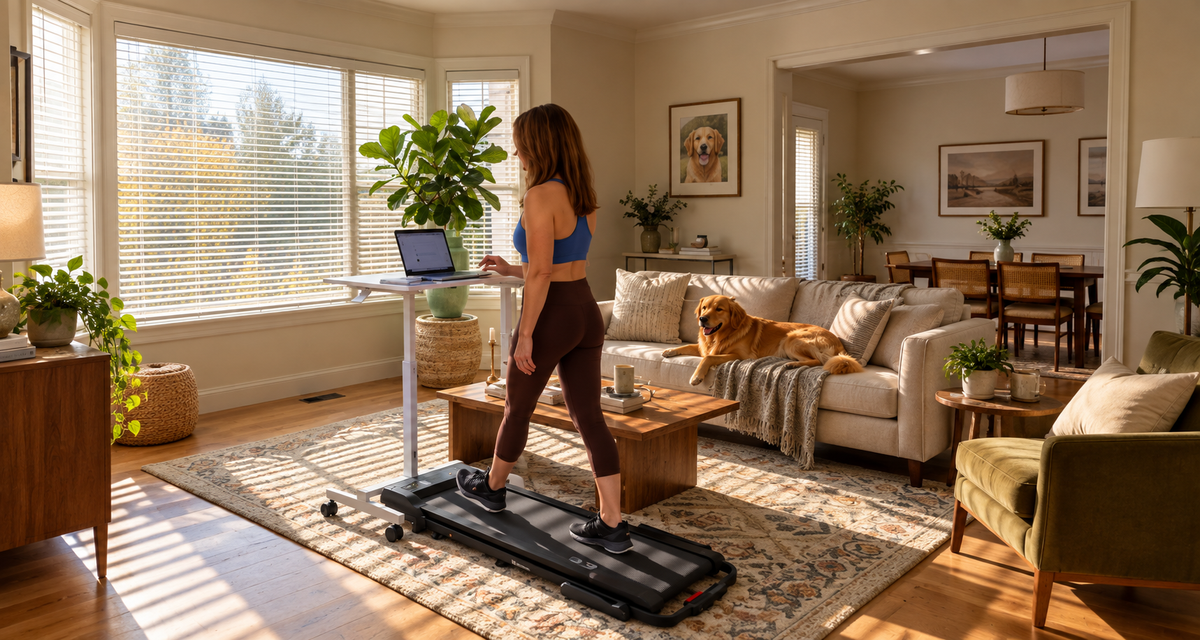
If you have pets at home, don’t choose a treadmill based only on whether it fits into an empty corner.
Three things matter more in everyday use: noise level, whether you mainly walk or run, and where the treadmill will go when you’re not using it.
If you simply want to get more steps while working or watching TV, the Q2 Urban is the better fit. If you want to walk during the week but still run on weekends, the A6 Plus gives you more flexibility.
Both operate at under 45 dB, but their speed ranges, running belts, and storage options are different. If your home already has a dog bed, cat tree, scratching post, and toy basket, it’s worth deciding from the start how you’ll use your treadmill—and where you’ll put it afterward.
1. If Your Pets Share the Room, Check the Treadmill Noise Level
If you plan to put your treadmill at home in the living room, bedroom, or home office, your cat or dog will probably hear it running almost every day.
Some pets are more sensitive to sudden sounds, vibrations, or changes in their environment. Your cat may be asleep on the couch when the treadmill starts. Your dog may normally nap beside your desk while an under-desk treadmill runs nearby for 20 or 30 minutes.
These are normal situations in a pet-friendly home.
That’s why treadmill noise shouldn’t be treated as just another specification.
Both the Q2 Urban and A6 Plus operate at under 45 dB, roughly comparable to a quiet office or soft conversation. If your cat is resting on the couch or your dog is lying near your desk, a lower operating noise level can make a treadmill easier to fit into a shared living space.
Actual noise can still vary depending on flooring, walking or running speed, and the condition of the machine. If you have hardwood floors, it’s also worth paying attention to how much vibration you notice once the treadmill is running.
There’s no need to encourage your pet to approach the treadmill the first time you use it, either. Let them get familiar with the new equipment while it’s turned off, then start with a low speed and short sessions.
2. If You Just Want to Walk Every Day, Q2 Urban Works Better for Small Spaces
If your main goal is getting more steps while working, walking while watching TV, or adding 20 minutes of light activity in the evening, you probably don’t need a larger running treadmill.
The Q2 Urban has a speed range of 0.6–3.8 MPH, making it a practical Walking Pad for everyday walking and home fitness.
Its overall dimensions are approximately 42.62"D × 19.69"W × 3.94"H, with a footprint of about 5.83 sq. ft. That’s roughly the amount of floor space taken up by a small coffee table.

That comparison becomes much more useful in a home with pets.
If your living room already has a dog bed, scratching post, and toy basket, the Q2 Urban doesn’t take over much additional floor space. At only 3.94 inches thick, it can be moved under a bed or desk, or into a low storage area beside the couch after your walk.
If your cat likes running across the living room or your dog regularly walks between the couch and the doorway, being able to move the treadmill out of the way after a workout matters more than simply finding a spot where it technically fits.
The Q2 Urban works especially well for this routine:
Take it out for a daily walk, then give the floor space back to the rest of your home.
3. Walk on Weekdays and Run on Weekends? A6 Plus Is More Flexible
If you walk during the week but genuinely want to run on weekends, there are a few more things to consider.
With the handrail lowered, the A6 Plus supports speeds from 0.6–3.8 MPH, making it suitable for everyday walking. Raise and secure the handrail, and the top speed increases to 7.5 MPH, giving you enough range for jogging and regular running workouts.
Its running belt measures approximately 380 × 1050 mm, or 14.96" × 41.34".
During low-speed walking, running belt dimensions may not seem especially important. Once you start running faster, however, the available belt space becomes much more noticeable.
Your stride gets longer, and during a continuous 20–30 minute treadmill workout, you need enough room for a comfortable and consistent foot strike.
That’s why the Q2 Urban is enough if you primarily want a Walking Pad, while the A6 Plus makes more sense if your home workouts include both walking and running.
There’s another practical consideration in a pet-friendly home.
If you already have a cat tree, pet bed, storage cabinet, and other furniture, adding both a separate Walking Pad and a full treadmill can quickly use up valuable space. The A6 Plus covers both walking and running in one machine, so you don’t have to find room for a second piece of cardio equipment.
For pet households, it can also be useful to look beyond speed and consider the treadmill’s everyday construction. The A6 Plus uses a 5-layer running belt, designed to support cushioning, stability, and regular use. In a home where cats and dogs are moving around frequently—and where cleaning may happen more often—these practical design details can matter more than appearance alone.
The A6 Plus also operates at under 45 dB, so even with its broader walking and running capabilities, it remains easier to accommodate in a shared home environment.

4. Both Are Easy to Store—But in Different Ways
The Q2 Urban is better suited to being tucked away.
Because the machine is only 3.94 inches thick, you can slide it under the bed if there’s enough clearance. In a small home office, it can go under the desk. If you don’t want exercise equipment permanently visible in the living room, you can move it beside the couch or against a wall.
That kind of storage works particularly well in homes with pets because you can largely restore their usual walking and play areas once you’re finished.
The A6 Plus takes a different approach.
Because it’s designed for running as well as walking, it needs a more complete workout area while in use. Once you’re finished, however, the treadmill can be folded and moved toward a wall or to the side of the room rather than remaining fully open.
If your cat follows the same route along the wall to reach a favorite window, or your dog regularly walks from the bedroom to the living room, think about those paths before deciding where to store your treadmill.
Before buying, take a tape measure and measure two spaces:
1. Workout Space
Measure where the treadmill will sit while you’re walking or running.
2. Storage Space
Measure where the machine will actually go when your workout is finished.
That tells you much more than looking at the unfolded dimensions on a product page alone—and makes it easier to see whether the treadmill will actually fit into your everyday home layout.
Choosing a Treadmill Shouldn’t Disrupt Your Pet’s Routine
In a home with cats or dogs, whether a treadmill works well depends on more than its speed and dimensions. It also depends on where that machine fits into everyday life.
Can your cat still reach its favorite window? Does your dog still have a clear path to its water bowl? Can your living room return to normal after your workout?
Those small details can make a big difference in whether a home treadmill or Walking Pad works long term.
Before buying, consider noise level, how you plan to exercise, running belt design, and storage space together.
That little bit of planning can make both your workouts—and your pet’s daily routine—much easier to live with.
Make Room for Your Workout—and Your Pets
Choose a DeerRun treadmill or Walking Pad that fits the way you exercise and makes home fitness easier to integrate into everyday life with cats and dogs.
Explore DeerRun Treadmills →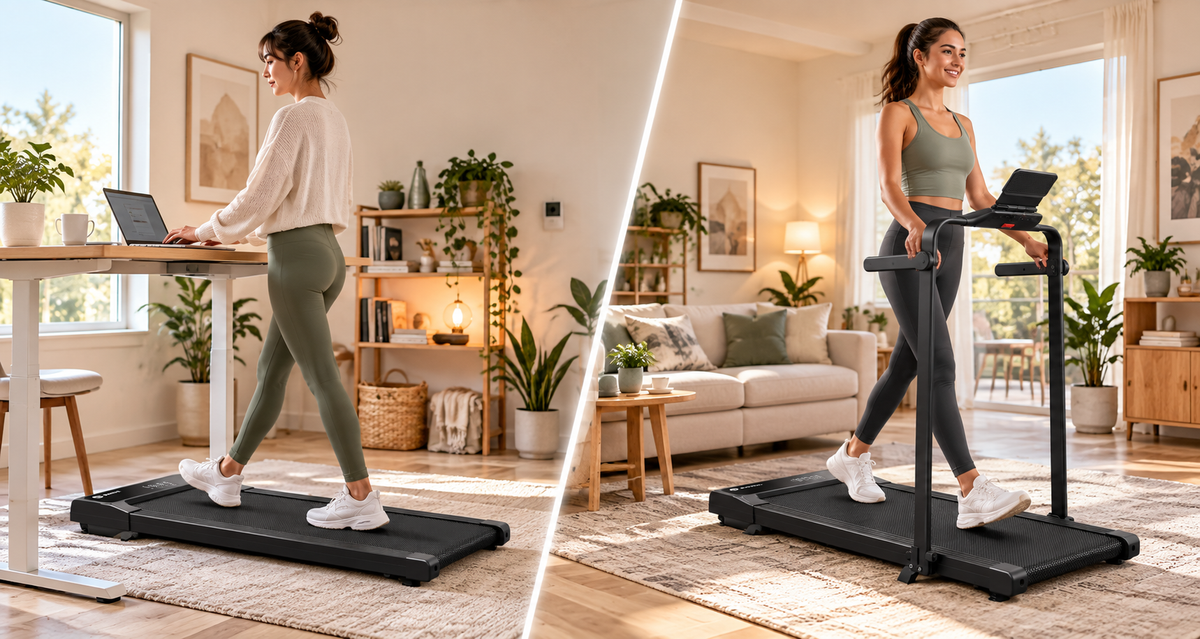


Leave a comment
This site is protected by hCaptcha and the hCaptcha Privacy Policy and Terms of Service apply.