





Word Count: ~950 words Estimated Reading Time: ~4 minutes
How long a home treadmill lasts cannot be determined by price, maximum weight capacity, or motor power alone. For consumers planning to use a treadmill at home for the long term, there are four easily overlooked details to pay attention to before purchasing: frame stability, repeated load capacity, safety switch durability, and the emergency stop function.
These details are related to the stable performance and safety of the treadmill during daily use, and they are difficult to judge solely from product images or specification sheets. Understanding whether a product has undergone relevant testing and what the test results represent can help you make a more informed choice before buying.
1. Frame Stability: Will It Wobble While Running?
DeerRun once received an email from a customer. She wanted to buy a home treadmill suitable for heavier users for her father. To encourage him to start exercising, she had previously purchased a treadmill on another platform. However, after only a week of use, the machine had problems: when her father slightly increased his walking speed, the frame would wobble, accompanied by obvious noise. This affected the exercise habit that had just been established with great difficulty.
This customer's experience also made DeerRun realize that for heavier users, a treadmill needs not only sufficient weight capacity but also a stable structure and reliable durability.
After receiving this request, DeerRun immediately communicated with the product R&D team, hoping to create a home treadmill that balances weight capacity, frame stability, and long-term usage needs. After multiple rounds of product design and testing, the DeerRun A6 Plus was born.

To further verify product performance and give consumers more peace of mind, DeerRun also invited the globally renowned third-party testing organization SGS to conduct ASTM standard-related tests on its corresponding test model, CT06.
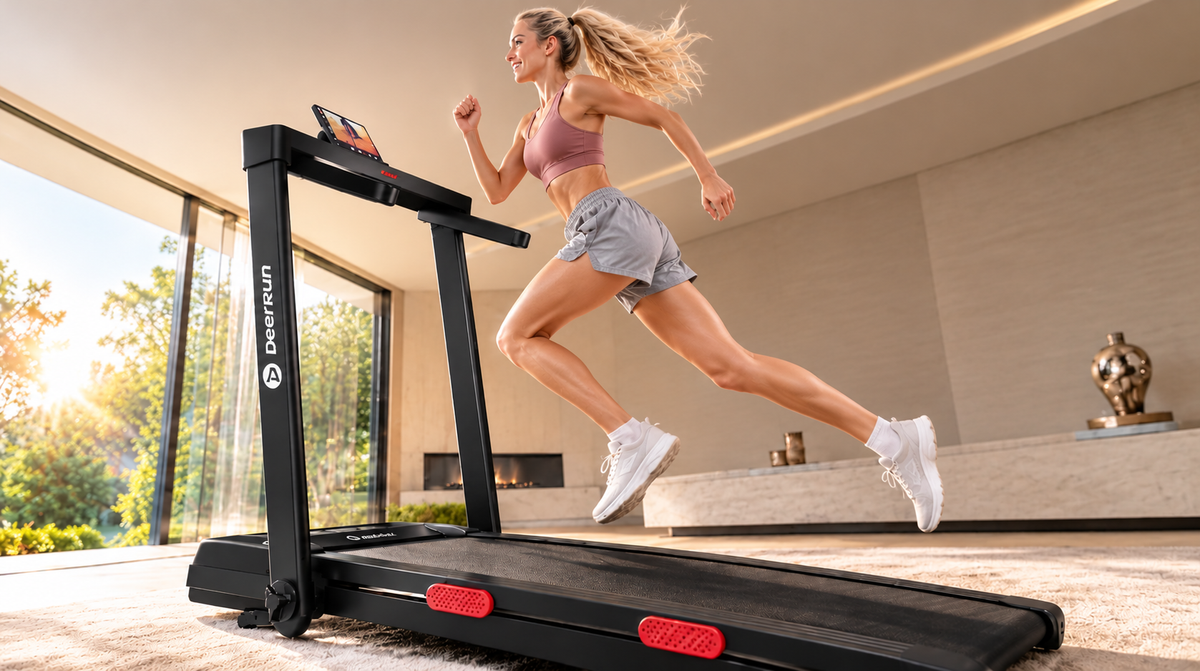
The DeerRun A6 Plus, corresponding to test model CT06, passed the ASTM F2115-25 stability-related tests executed by the globally renowned third-party testing organization SGS. The test report number is GZES260701410831.

After months of R&D optimization and multiple rounds of testing, the A6 Plus also needed to undergo further ASTM standard testing. ASTM F2115-25 is a safety and performance standard for treadmills that has clear requirements for frame stability and is evaluated in conjunction with the test methods specified in ASTM F2106-25. Successfully passing this third-party test by SGS demonstrates that the A6 Plus's frame stability has withstood the test challenges specified by the standard.
For everyday users, this means that whether walking briskly or running, they can get more stable equipment support, reducing the discomfort caused by frame wobbling and making home workouts more reassuring.
2. Endurance Load: Can the Treadmill Withstand Repeated Walking and Running?
A treadmill must bear the repeated impact of the user's weight and footsteps every day. For example, exercising for 30 minutes a day at 120 steps per minute results in approximately 1.31 million steps per year. Long-term use is a test for both the running belt and the frame structure.
This is why it is worth paying attention to endurance load testing when buying a treadmill.
In the relevant treadmill testing requirements of ASTM F2115-25, the endurance load test requirement for consumer-grade treadmills involves at least 375,000 cycles, with a test load of 1.5 times the manufacturer's stated maximum user weight.
In the CT06 test report corresponding to the DeerRun A6 Plus, the result for this test item is Pass.

This means that CT06 passed the 375,000-cycle endurance load test under the specified load. For consumers, this indicates that the treadmill has been tested to withstand repeated loads, giving them more confidence to use it for daily walking and running without having to judge durability solely by appearance.
3. Safety Switch: Can It Still Work After Repeated Operation?
The pause and stop buttons on a treadmill may rarely attract attention in daily life. However, during a workout, if you need to answer a phone call, temporarily step away, or suddenly want to end your training, these control devices come in handy.
Therefore, the safety switch must not only work properly on first use but also withstand daily repeated operations.
The CT06 test report records the durability tests for switches and operating mechanisms related to the stop, pause, or end functions. The test requirement involves 1,560 operations, with a result of Pass.

The switches related to the stop, pause, and end functions of the A6 Plus passed the 1,560 repeated operation tests. Whether temporarily pausing during a workout or ending a training session, the commonly used control buttons have been verified through repeated operations, making daily use more reliable and eliminating worries that frequent operation might affect the normal use of the switches.
4. Emergency Stop: Can It Stop in Time in Unexpected Situations?
When exercising at home, unexpected situations can happen at any time. For example, slipping, sudden physical discomfort, or needing to stop exercising immediately. At such times, the emergency stop device is particularly important.
When buying a treadmill, in addition to checking whether it is equipped with an emergency stop function, you should also pay attention to whether the device is easy to reach and whether the running belt can stop as required after being triggered.
In the CT06 ASTM tests, the emergency stop device underwent relevant checks, including:
- Whether users can easily reach the emergency stop device;
- Whether the stop function can be triggered through methods such as a safety lanyard;
- Whether the exercise surface can decelerate and stop after the emergency stop is triggered.
CT06 passed the above emergency stop-related tests. This means that in unexpected situations during exercise, users can reach and trigger the emergency stop device to let the running belt decelerate and stop, promptly ending the workout. For people exercising alone at home, this function is especially important, providing a way to quickly stop the treadmill when needed.

When we provided this product to the caring daughter who originally wrote to us looking for a treadmill for her father, she was especially grateful. We are also very happy that within limited space, budget, and time, she was able to buy a treadmill suitable for her father and use it with confidence and continuity.
DeerRun has always been updating its blog and altruistic content to educate ordinary families on how to choose and use suitable treadmills, delivering them to consumers at reasonable prices.
5. FAQ: 3 Common Questions About Home Treadmill Durability
Q1. How long does a home treadmill usually last?
There is no uniform lifespan for home treadmills. Actual usage time will be affected by factors such as usage frequency, exercise intensity, user weight, product structure, and daily maintenance. When purchasing, you can pay attention to the product's durability testing, warranty policy, and after-sales service, rather than just comparing stated specifications.
Q2. Does using a treadmill every day shorten its lifespan?
Daily use does not necessarily mean the treadmill will wear out faster. The key is whether the equipment suits your exercise needs and whether it is used and maintained according to the product instructions. Before buying, you should choose a suitable model based on your exercise frequency and training style.
Q3. What should I look for when buying a durable treadmill?
In addition to maximum weight capacity and motor specifications, it is recommended to focus on frame stability, endurance load testing, safety switch testing, and the emergency stop function. At the same time, you should also understand the product's warranty coverage and after-sales support.
6. Choose a Treadmill with Confidence
When choosing a home treadmill, what is truly worth paying attention to is not just what features it has when you first buy it, but also whether it has undergone tests related to daily use.
From frame stability and repeated loads to safety switches and the emergency stop function, these details can help consumers gain a more comprehensive understanding of a treadmill's design and testing performance.
DeerRun hopes to help consumers find home fitness equipment that truly suits them based on family space, exercise habits, and training goals through a deep understanding of treadmill products, usage scenarios, and quality testing.
Understanding these details before buying a treadmill can make your choice more informed and your daily workouts more reassuring.
Experience the Durability of DeerRun A6 Plus
Discover reliable, space-saving equipment built with rigorous testing and stability designed for your home workouts.
Explore DeerRun A6 Plus →


Leave a comment
This site is protected by hCaptcha and the hCaptcha Privacy Policy and Terms of Service apply.