





Word Count: Approx. 1,300 words
Reading Time: About 6 minutes
You climb five flights of stairs and start breathing heavily, with your legs feeling sore. But when you switch to incline walking on a treadmill, you can keep going for 20 minutes.
If stair climbing feels harder, does that automatically mean you burn more calories? Not necessarily.
For the same 20-minute workout, walking at 3 MPH with a 12% incline has an estimated calorie expenditure of approximately 188 kcal, compared with around 154 kcal for regular stair climbing, based on a 150 lb (68 kg) adult.
Steep incline walking may not only burn more calories per minute but also help avoid some of the repetitive knee joint loading associated with climbing and descending stairs.
1. Why Does Stair Climbing Leave You Breathless So Quickly, While Incline Walking Feels More Sustainable?
1.1 Stair Climbing: High Intensity, but Hard to Sustain
Every time you step onto a higher stair, your leg muscles have to generate force to push your body upward.
Generally, the higher the steps and the faster you climb, the more demanding the activity becomes.
However, climbing five flights of stairs may take only two or three minutes. Once you reach your destination, you have to stop or turn around.
Climbing five flights continuously also places different demands on your body than taking a 30-second break after each flight.
The biggest limitation of stair climbing isn't a lack of intensity. It's the difficulty of maintaining a steady workout intensity for an extended period in everyday settings.

1.2 Incline Walking: Increase Intensity Without Increasing Speed
With incline treadmill walking, you can increase workout intensity by raising the incline rather than simply walking faster.
For example, at the same speed of 3 MPH:
- 0% incline: Regular flat treadmill walking.
- 6% incline: Adds uphill resistance, potentially making your breathing noticeably faster.
- 12% incline: Places greater uphill demands on your lower-body muscles.
A treadmill also allows you to maintain a consistent speed and incline without stopping when you reach the top of a flight of stairs.
So, what makes the difference isn't just how demanding an exercise feels, but also how long you can sustain it.
2. Incline Walking vs. Stair Climbing: How Many More Calories Can You Burn in 20 Minutes?
2.1 The Numbers Tell You More Than Sweat or Heavy Breathing
Stair climbing is certainly demanding, but incline walking isn't necessarily as easy as it looks.
Even at the same walking speed, increasing the incline from 0% to 12% can significantly change how hard your body has to work.
So, if both activities last 20 minutes, how much does calorie expenditure actually differ?
Let's compare the estimated results for a 150 lb (68 kg) adult.
| Exercise | Estimated Intensity | Estimated Calories Burned in 20 Minutes |
|---|---|---|
| Flat Walking, 3 MPH | 3.3 METs | Approximately 75 kcal |
| Incline Walking, 3 MPH, 6% Incline | 5.8 METs | Approximately 131 kcal |
| Regular Stair Climbing | 6.8 METs | Approximately 154 kcal |
| Incline Walking, 3 MPH, 12% Incline | 8.3 METs | Approximately 188 kcal |
Note: MET (Metabolic Equivalent of Task) is used to measure exercise intensity. Stair-climbing values are based on the 2024 Adult Compendium of Physical Activities, while incline-walking estimates are calculated using the ACSM walking metabolic equation. All estimates assume 20 minutes of continuous exercise. Stair climbing excludes breaks and descending stairs, while incline walking assumes a constant speed and incline throughout.
The comparison is clear: Walking at a 12% incline has a higher estimated calorie expenditure than regular stair climbing.
Steep incline walking can be a vigorous aerobic workout. Stair climbing isn't the only way to make your cardiovascular system work harder.
2.2 Don't Confuse Getting Tired Faster With Getting a Better Workout
Climbing five flights of stairs might take only two or three minutes.
Incline walking, on the other hand, can be maintained for a planned 20-minute session.
The first activity may involve higher intensity over a short period, while the second makes it easier to accumulate more continuous exercise time.
If you only compare how breathless each workout makes you feel, it's easy to overlook the role exercise duration plays in total calorie expenditure.

3. Stair Climbing Works Your Legs, but What About Your Knees?
3.1 Stair Climbing: Your Legs Work Hard, but Knee Joint Loading Also Increases
When climbing stairs, your knees repeatedly bend and extend as your leg muscles help push your body upward.
Compared with walking on level ground, stair climbing produces higher values for certain measures of knee joint loading.
Descending stairs also requires your knee joints and surrounding muscles to control your body's downward movement. It's not simply the reverse of walking upstairs.
Although stair climbing can strengthen the demands placed on your leg muscles, repeatedly going up and down stairs also increases knee joint loading.
For people who already experience knee discomfort, climbing more stairs doesn't necessarily mean a better workout. It may make their symptoms worse.
If your knees hurt after every stair-climbing session, increasing the number of flights isn't a good way to challenge yourself.
3.2 Incline Walking: No Repeated Steps, and Cushioning Matters
Incline walking doesn't require you to repeatedly step up onto raised surfaces.
Instead, you can adjust the workout demands through speed and incline.
Compared with hard stair surfaces, a treadmill with a cushioning system may also provide a more comfortable experience underfoot.
For example, the DeerRun Z10 Pro features a five-layer cushioned running belt, designed to absorb some of the impact during foot strikes and make walking and jogging more comfortable.
Rather than constantly trying to climb higher, consider a workout that allows you to control the intensity while maintaining a comfortable walking experience.
Of course, cushioning doesn't eliminate all joint loading.
A steep incline can still increase the demands on your lower body. If you experience knee pain, stop the workout or reduce the intensity.
4. How Should You Use Incline Walking to Increase Calorie Expenditure?
4.1 A 12% Incline Is Challenging, but You Don't Have to Start There
A steeper incline can increase exercise intensity, but jumping straight from flat walking to a 12% incline may make it difficult to complete your planned workout.
A more practical approach is to keep your speed consistent and gradually increase the incline.
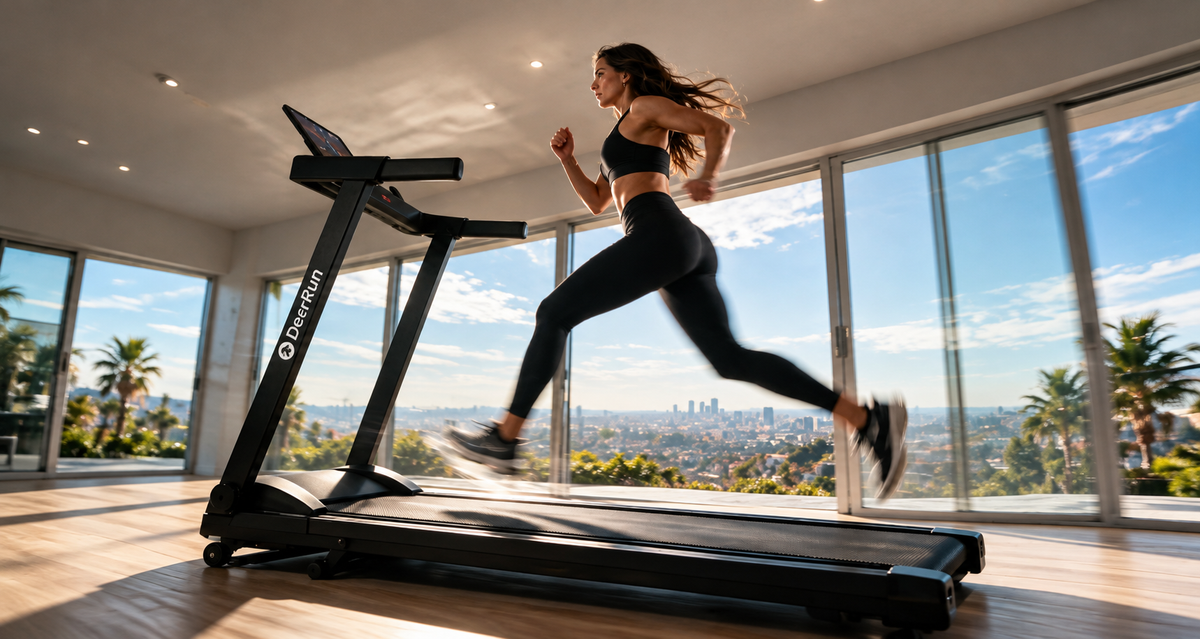
The DeerRun Z10 Pro Treadmill offers a speed range of 0.6–7.5 MPH and up to a 12% automatic incline, supporting everyday walking as well as jogging and running.
You can adjust the incline directly during your workout without stopping to make manual changes.
This makes it easier to modify your workout intensity according to your training plan and how you're feeling.
4.2 Start With This 20-Minute Incline Walking Workout
If you're already comfortable with regular flat walking, try the following 20-minute incline treadmill workout.
| Workout Phase | Duration | Speed | Incline |
|---|---|---|---|
| Walking Warm-Up | 5 minutes | 2.0–2.5 MPH | 0% |
| Introduce Incline | 5 minutes | 2.0–2.5 MPH | 3% |
| Increase the Challenge | 5 minutes | 2.0–2.5 MPH | 3–6% |
| Slow Down and Cool Down | 5 minutes | 1.5–2.0 MPH | 0% |
If this is your first incline walking workout, you can keep the incline at 3% or lower throughout the session.
You don't need to measure workout intensity by how much you sweat.
If you're breathing faster than usual but can still speak in full sentences, the intensity is generally manageable.
If speaking becomes difficult, reduce your speed or incline.
Conclusion: Harder Doesn't Always Mean More Effective
Stair climbing can help you add more physical activity to your daily routine, but that doesn't mean it always burns more calories than incline walking.
At certain speeds and incline levels, incline walking may burn more calories per minute than regular stair climbing.
More importantly, a treadmill allows you to control workout intensity, while a cushioned running belt can improve comfort underfoot.
Don't judge workout effectiveness by how breathless you feel. Choosing a manageable intensity and completing your workout matters more than simply pushing yourself to feel exhausted.
Ready to Try Incline Walking?
From flat walking to workouts with up to a 12% incline, the DeerRun Z10 Pro lets you adjust your speed and incline at home.
Combined with its five-layer cushioned running belt, it offers a more comfortable way to explore different incline walking workouts.
Explore DeerRun Z10 Pro →


Leave a comment
This site is protected by hCaptcha and the hCaptcha Privacy Policy and Terms of Service apply.