





Word Count: Approx. 1000 words
Reading Time: About 5 minutes
When people want to increase their calorie burn, their first thought is usually:
Run faster or run longer.
But there’s another way that can increase workout intensity more effectively:
Incline training.
For people who don’t enjoy high-speed running, have limited time, or are already used to light exercise, incline treadmill training can offer a more controlled way to make workouts more challenging.
But incline training isn’t simply about setting the treadmill to the highest level.
Why does incline make a workout feel more intense? Is 10 minutes of incline training worth it? And how should beginners get started?
1. Why Can Light Exercise Start to Feel Like “Not Enough”?
Many people do exercise regularly but stay at a relatively low intensity.
Walking and light exercise still have value. But if you already have some exercise experience and your usual workouts have started to feel easier, it may be worth gradually increasing the intensity.
One simple concept can help explain this:
MET (Metabolic Equivalent of Task)
MET is a way to describe the relative energy demands of different physical activities.
A rough estimate of energy expenditure can be calculated as:
Calories burned ≈ MET × body weight (kg) × exercise time (hours)
This means that when body weight and exercise duration are similar, higher-intensity activities generally burn more energy per unit of time.
So, if you only have 30 minutes to exercise, instead of simply trying to work out for longer, you can consider:
Increasing the intensity within a level you can comfortably handle.
Incline training is one way to do that.
2. Why Does Adding Incline Make a Workout More Challenging?
When you walk or run on a flat surface, your body mainly moves horizontally.
Once the treadmill starts going uphill, you also have to work against gravity to move your body upward.
So, at a similar speed:
Incline ↑ → Exercise demand ↑ → Heart rate usually ↑ → Energy expenditure usually ↑
That is the basic principle behind incline training.
It does not mean:
Higher incline = automatically better fat loss.
The real benefit is:
Increasing incline can raise workout intensity within the same amount of exercise time.
So, if you don’t enjoy high-speed running, adding a moderate incline can be another way to make your workout more challenging.

3. How Should Beginners Start? Try the “3-3-3” Incline Routine
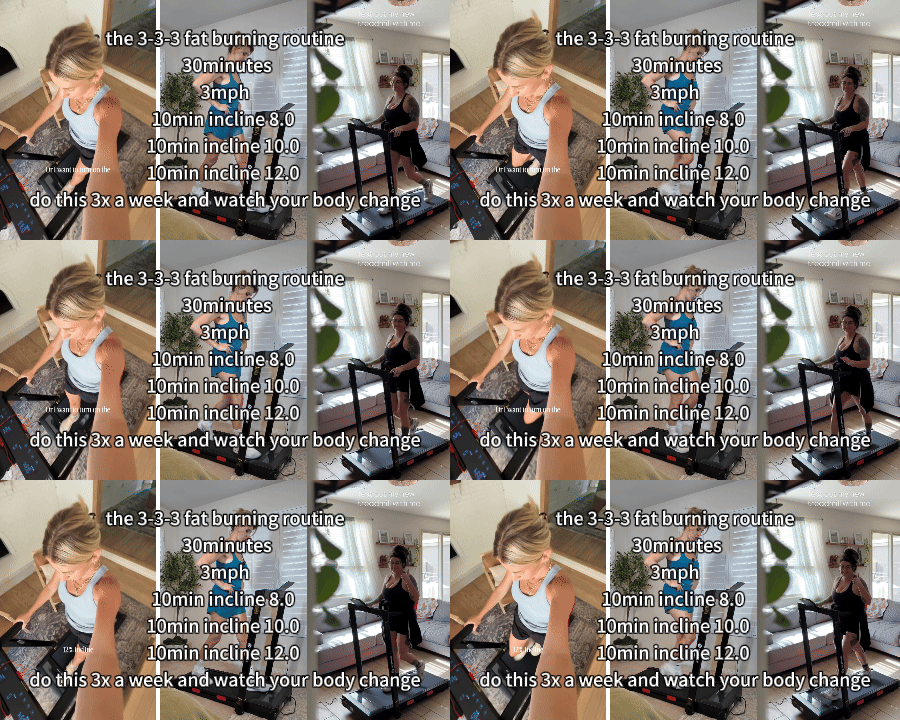
You may have seen the 3-3-3 fat-burning routine trending online. The idea is simple: keep your speed relatively steady while gradually increasing the incline over 30 minutes.
The 3-3-3 Fat-Burning Routine
30 minutes · around 3 MPH
8% incline
10% incline
12% incline
The key isn't any one specific number. It’s about keeping your speed relatively steady and gradually increasing the incline, allowing the workout intensity to build as you go.
At around 3 MPH, increasing the incline from 8% to 12% requires your body to continuously work against gravity, making the workout considerably more demanding than walking on a flat surface. For a 150-pound (about 68 kg) adult, this 30-minute workout could roughly burn 200–300 calories, although actual energy expenditure varies depending on body weight, gait, workout intensity, and individual fitness level.
In terms of exercise intensity, it is closer to continuous uphill walking or hiking than ordinary flat-surface walking. Incline training also increases the involvement of the lower body, particularly the glutes, quadriceps, calves, and hamstrings, while the core muscles also help stabilize the body.
For beginners, 3 MPH and a 12% incline do not need to be strict targets. Maintain a speed that feels appropriate for you and gradually increase the incline as your fitness improves. If 12% feels too challenging, stay at a lower incline and work your way up as your body adapts.
What matters most is gradually increasing the challenge while keeping the workout sustainable enough to stick with long term.
30-minute incline treadmill workout demonstration
Don’t Forget to Cool Down and Stretch
After completing the 30-minute incline treadmill workout, don’t stop suddenly.
Spend another 5 minutes gradually lowering the incline and speed:
5 min → 0–3% incline · 2–2.5 MPH
This gives your heart rate and breathing time to gradually return toward normal.
Afterward, you can spend a few minutes doing some simple stretches, focusing on the calves, quadriceps, hamstrings, and glutes.
4. No Time to Exercise? 10 Minutes of Incline Training Can Still Be a Start
Many people want to exercise but feel they need a full hour to make it worthwhile.
In reality, shorter workouts can also help you build consistency.
For example, if you only have 10 minutes after getting home:
2 min → Warm-up
↓
6 min → Moderate incline
↓
2 min → Cool-down
The entire workout takes just 10 minutes.
Of course, 10 minutes cannot replace a complete training program, but it can lower the barrier to getting started.
Once 10 minutes starts to feel manageable, you can gradually build up:
20 minutes → 30 minutes
For long-term exercise, being able to stay consistent matters more than pushing yourself extremely hard once in a while.
5. Higher Incline Isn't Always Better
Seeing someone use a 12% or even 15% incline doesn't mean you need to start there too.
Workout intensity depends on more than incline, including:
- Speed
- Exercise duration
- Heart rate
- Fitness level
- Training experience
If you are already struggling to breathe comfortably when you start climbing, increasing the incline further isn't necessarily the answer.
Instead:
Lower the incline → stabilize the intensity → gradually increase training time.
The goal isn't:
“How high was my incline today?”
It's:
“Is this intensity right for me, and can I complete the workout consistently?”
6. Why Is a Treadmill Useful for Incline Training?
Incline training requires you to adjust several key variables:
Speed + Incline + Time
A treadmill makes these variables easier to control.
For example, the DeerRun Z10 Pro offers up to 12% automatic incline, allowing you to adjust the incline and speed to change workout intensity as you progress from basic incline training.
Finding the right intensity for you is what makes it easier to stay consistent.
Start Your Incline Training ⛰️
Find your ideal intensity and make your home workouts more effective.
Explore DeerRun Z10 Pro →


Leave a comment
This site is protected by hCaptcha and the hCaptcha Privacy Policy and Terms of Service apply.