





Word Count: Approx. 1,100 words | Read Time: About 5 minutes
If you don’t have a dedicated home gym and need to put your treadmill away after every workout, being “foldable” is only the first thing to consider.
What really affects everyday use is how much space it takes up when stored, how easy it is to move, how simple the storage process is, whether you actually have a practical place to keep it, and how quickly you can get it ready for your next workout.
Those details can determine whether you’re willing to put your treadmill away every day—or whether it eventually stays in the middle of your living room because moving it feels like too much trouble.
Whether you mainly walk or run, the DeerRun Q2 Urban and DeerRun Z10 Pro can both help free up living space when they’re not in use. But they store differently, making them better suited to different homes and workout habits.
1. How Much Space Does It Take Up When Stored?
If you use your treadmill every day, even for just 20–30 minutes, its storage dimensions become something you deal with every single day.
They determine whether the treadmill can actually fit under a bed or stay neatly against a wall—not just whether its unfolded dimensions fit somewhere in your home.
The Q2 Urban is only about 3.94 inches thick and has a footprint of approximately 5.83 sq. ft., roughly the floor space of a small coffee table.
It doesn’t require an additional folding step. When you finish walking, its low-profile design makes it easier to slide under a bed or desk, or store in another low-clearance area beside a sofa.
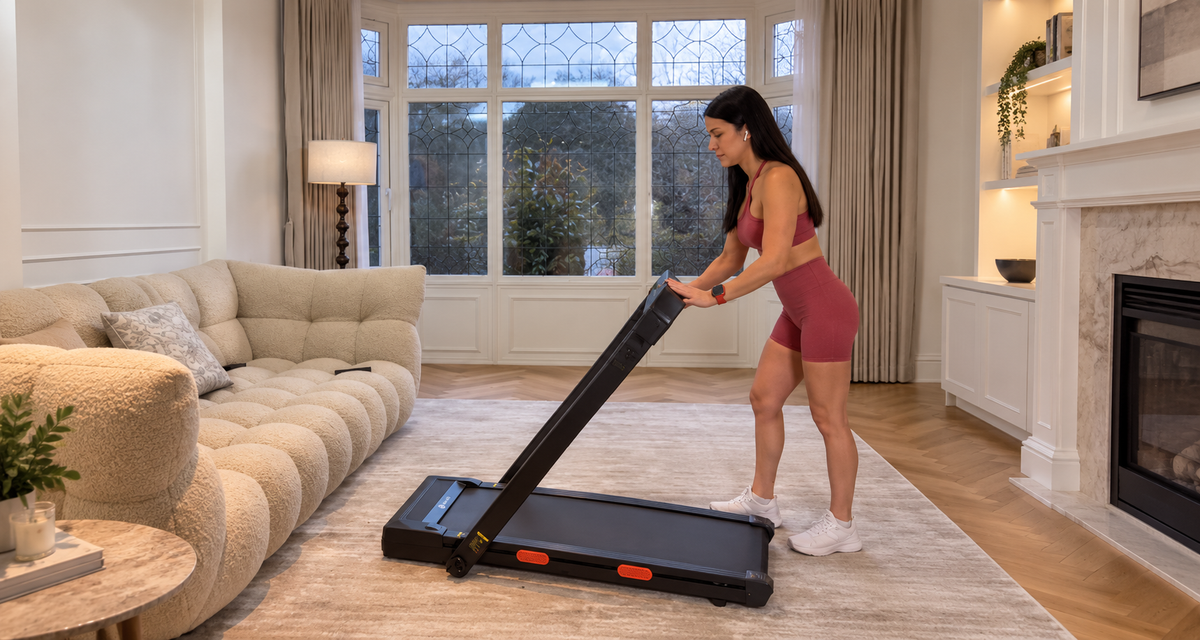
The Z10 Pro measures approximately 51.34"D × 26.77"W × 47.01"H when in use, with a footprint of about 9.55 sq. ft. When folded, it is approximately 5.63 inches thick—roughly comparable to a slim storage bin—making it easier to keep against a wall or beside a cabinet.
Both treadmills can free up the middle of the room when you’re finished exercising, but they do it differently:
Q2 Urban
Best for low-clearance storage
3.94" thick
Approx. 5.83 sq. ft. footprint
Slide under a bed, desk, or other low-clearance space
Z10 Pro
Best for folding and storing off to the side
Approx. 5.63" thick when folded
Fold down after your workout
Store against a wall or beside a cabinet
2. Moving It Every Day? Wheels and Overall Size Matter
Putting a treadmill away often means moving it somewhere else first.
If you repeat that process every day, the difference between an easy-to-move treadmill and an awkward one becomes noticeable very quickly.
Maybe you use your treadmill beside your desk during the day and move it back against the wall at night. Or perhaps you work out in the living room and want to reclaim the floor space as soon as you’re finished.
In situations like these, transport wheels, overall size, and how easily the treadmill moves once stored can matter more than whether the product is technically labeled “foldable.”
Both the Q2 Urban and Z10 Pro come with wheels, so you can roll them into position instead of lifting the entire machine every time.
That can make a meaningful difference if you regularly move your treadmill around a living room, bedroom, or home office.
If the treadmill changes locations every day, don’t just ask:
“Can I fold it?”
Also ask: “Once it’s folded or stored, can I actually move it easily?”

3. If You Store It Every Day, Simpler Is Better
When your daily workout lasts only 20–30 minutes, putting your treadmill away shouldn’t become another project.
Removing parts, assembling them again, or moving furniture every time you exercise can quickly make a “foldable treadmill” feel much less convenient.
The Z10 Pro is a 2-in-1 folding treadmill with a fold-down handrail, making it easier to switch between different uses.
With the handrail down, it can be used as a walking treadmill. When you want to run, raise the handrail and switch into running mode without changing machines or going through a complicated setup.
That works particularly well when your activity changes throughout the day.
For example, you might keep the handrail down for low-speed walking while working from home. Later in the evening, you can raise it for a running workout. When you’re finished, lower the handrail again for storage.
For a treadmill that gets taken out and put away every day, the easier it is to switch between workout and storage modes, the less friction it adds to your routine.

4. Don’t Just Ask Whether It Stores Well—Make Sure It Supports Your Workouts
Storage matters, but it shouldn’t come at the expense of the workouts you actually want to do.
Walking and running, for example, require very different speed ranges.
If you mainly want to add steps while working, walk while watching TV, or fit in 20–30 minutes of light daily activity, the Q2 Urban’s 0.6–3.8 MPH speed range covers most everyday walking needs.
If you also want to jog, run, or add incline training, the Z10 Pro gives you more room to work with.
The Z10 Pro supports speeds from 0.6–7.5 MPH and offers up to 12% automatic incline.
You can use it for low-speed walking during the day and running workouts later on. When you want more training variety, you can adjust the incline without having to rely only on increasing speed.
The difference between the two becomes clearer when you start with your actual workout habits.
| Your Main Need | Better Fit | Why |
|---|---|---|
| Extra steps while working or 20–30 minutes of everyday walking | Q2 Urban | More compact and better suited to low-clearance storage |
| Walking, running, and incline training from the same machine | Z10 Pro | Broader training range with running and automatic incline |
That way, you don’t end up buying a larger treadmill for features you rarely use—or choosing the smallest option only to discover that it doesn’t support the workouts you actually want.
5. The Best Treadmill for Storage Is the One You’ll Actually Put Away
“Foldable” is ultimately just a product feature.
For everyday use, what matters more is how compact the treadmill becomes, how easily you can move it, how many steps it takes to store, and whether its storage design actually works with your home.
Think about where the treadmill will go after your workout—not just where it will sit while you’re exercising.
If those details make sense before you buy, it becomes much easier to reclaim your living space after every workout without turning storage into another chore.
And when taking out and putting away your treadmill feels simple, it’s easier to keep exercise as part of your everyday routine.
Before You Buy: 5-Point Treadmill Storage Checklist
☐ Stored size: Will it actually fit under your bed, desk, or beside the wall?
☐ Moving: Can you roll it into storage without lifting the entire treadmill?
☐ Storage steps: Can you put it away without removing parts or rearranging furniture?
☐ Workout range: Does the compact design still support the walking, running, or incline workouts you want?
☐ Daily setup: Will getting it back out tomorrow feel easy enough that you’ll actually use it?
Make Your Treadmill Easy to Use—and Easy to Store
Choose a DeerRun treadmill that fits both your workout routine and the way you actually use your space at home.
Explore DeerRun Treadmills →


Leave a comment
This site is protected by hCaptcha and the hCaptcha Privacy Policy and Terms of Service apply.